GENEVA · 14 JUNE 2026
International Coalition for Human Rights Condemns the Exploitation of Sudan's Doctors Network and Emergency Response Rooms as Military Intelligence Tools
At the 62nd Session of the United Nations Human Rights Council at the Palais des Nations in Geneva, the International Coalition for Human Rights condemned the exploitation of Sudan's Doctors Network and Emergency Response Rooms as military intelligence tools, and urged the Council to uphold medical neutrality and protect healthcare workers in Sudan.
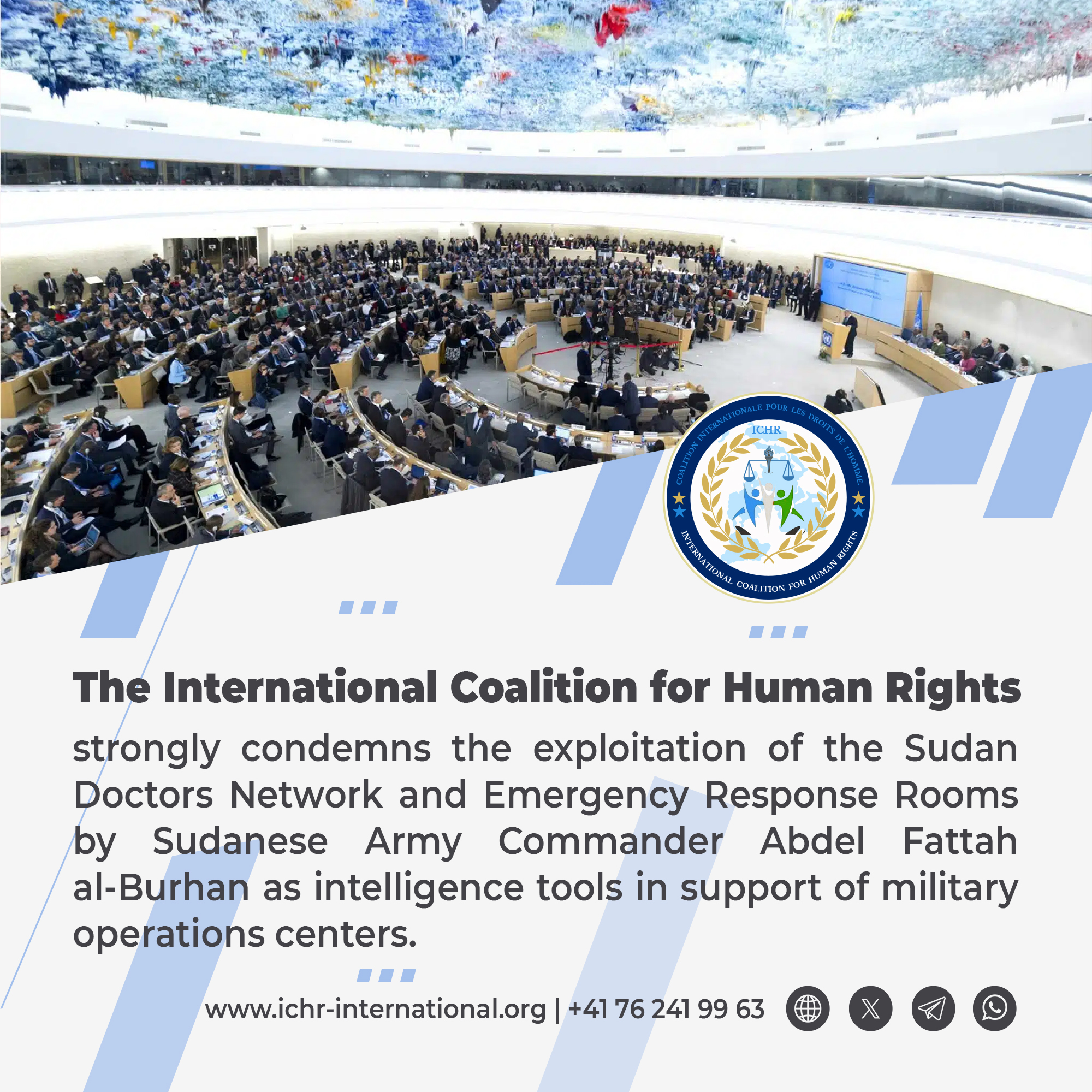
62nd Session — Palais des Nations — June 2026. The Secretary-General has received the following statement.
The International Coalition for Human Rights strongly condemns the exploitation of the Sudan Doctors Network and Emergency Response Rooms by Sudanese Army Commander Abdel Fattah al-Burhan as intelligence tools in support of military operations centers.
How Has the Conflict in Sudan Eroded Medical and Humanitarian Neutrality?
The ongoing armed conflict in Sudan, which began on 15 April 2023, continues to generate grave humanitarian and human rights consequences. Beyond the direct impact of hostilities on civilians, increasing concerns have emerged regarding the protection of medical neutrality, the independence of healthcare providers, and the integrity of humanitarian action.
Medical neutrality constitutes a fundamental principle of international humanitarian law. Medical personnel, healthcare facilities, and humanitarian actors must be able to perform their functions impartially, free from military, political, or security-related interference. Respect for this principle is essential to ensuring access to healthcare and protecting civilian populations affected by armed conflict.
Recent developments have raised concerns regarding the increasing politicization of medical and humanitarian structures in Sudan. Public statements attributed to senior military officials regarding the involvement of medical professionals in support functions connected to military operations have generated concerns about the perceived independence of healthcare institutions and personnel. Such developments risk undermining public confidence in the neutrality of medical services and may expose healthcare workers to additional security risks.
Concerns Regarding the Independence of Medical and Humanitarian Networks
Reports issued by civil society organizations and human rights monitors during 2026 have highlighted allegations concerning the politicization of certain medical and humanitarian initiatives operating in conflict-affected areas. These concerns include:
- The possible use of medical reporting mechanisms in ways that may compromise the principles of impartiality and objectivity;
- Allegations of selective documentation of violations affecting particular communities or geographic areas;
- The risk that humanitarian platforms may be perceived as contributing to political or military narratives rather than serving exclusively humanitarian purposes.
If left unaddressed, such concerns may weaken public trust in humanitarian institutions and undermine the credibility of documentation efforts intended to support accountability and the protection of victims.
Attacks on Healthcare Facilities and Medical Personnel
At the same time, reports of attacks against healthcare facilities, medical personnel, ambulances, and humanitarian infrastructure continue to raise serious concerns. International humanitarian law, including the Geneva Conventions and their Additional Protocols, affords special protection to medical units and personnel during armed conflict.
Any deliberate attack against protected medical facilities or personnel, or any misuse of healthcare institutions for military purposes, may constitute a serious violation of international humanitarian law and could give rise to individual criminal responsibility under international law.
The destruction, disruption, or politicization of healthcare services has further restricted access to life-saving treatment for millions of civilians, including internally displaced persons, women, children, older persons, and persons with disabilities.
Recommendations
The International Coalition for Human Rights respectfully calls upon the Human Rights Council and relevant United Nations mechanisms to:
- Urge all parties to the conflict to respect and uphold the principle of medical neutrality in accordance with international humanitarian law;
- Demand the immediate cessation of all forms of military, political, or security interference in the work of healthcare institutions, medical personnel, and humanitarian actors;
- Support independent, impartial, and transparent investigations into allegations concerning the politicization of medical and humanitarian reporting;
- Strengthen monitoring and accountability mechanisms relating to attacks on healthcare facilities and medical personnel;
- Ensure that all victims of violations are documented and protected without discrimination and regardless of geographic, ethnic, political, or social affiliation;
- Promote measures aimed at restoring public confidence in the independence, impartiality, and integrity of Sudan's healthcare and humanitarian sectors.
The protection of medical neutrality is indispensable to the preservation of human dignity, the delivery of humanitarian assistance, and the pursuit of justice and accountability in Sudan. The international community must take all appropriate measures to ensure that healthcare services remain protected from the effects of political and military confrontation.
International Coalition for Human Rights
Gallery
- #international_coalition_for_h_rights
- #Sudan