GENEVA · 8 NOVEMBER 2026
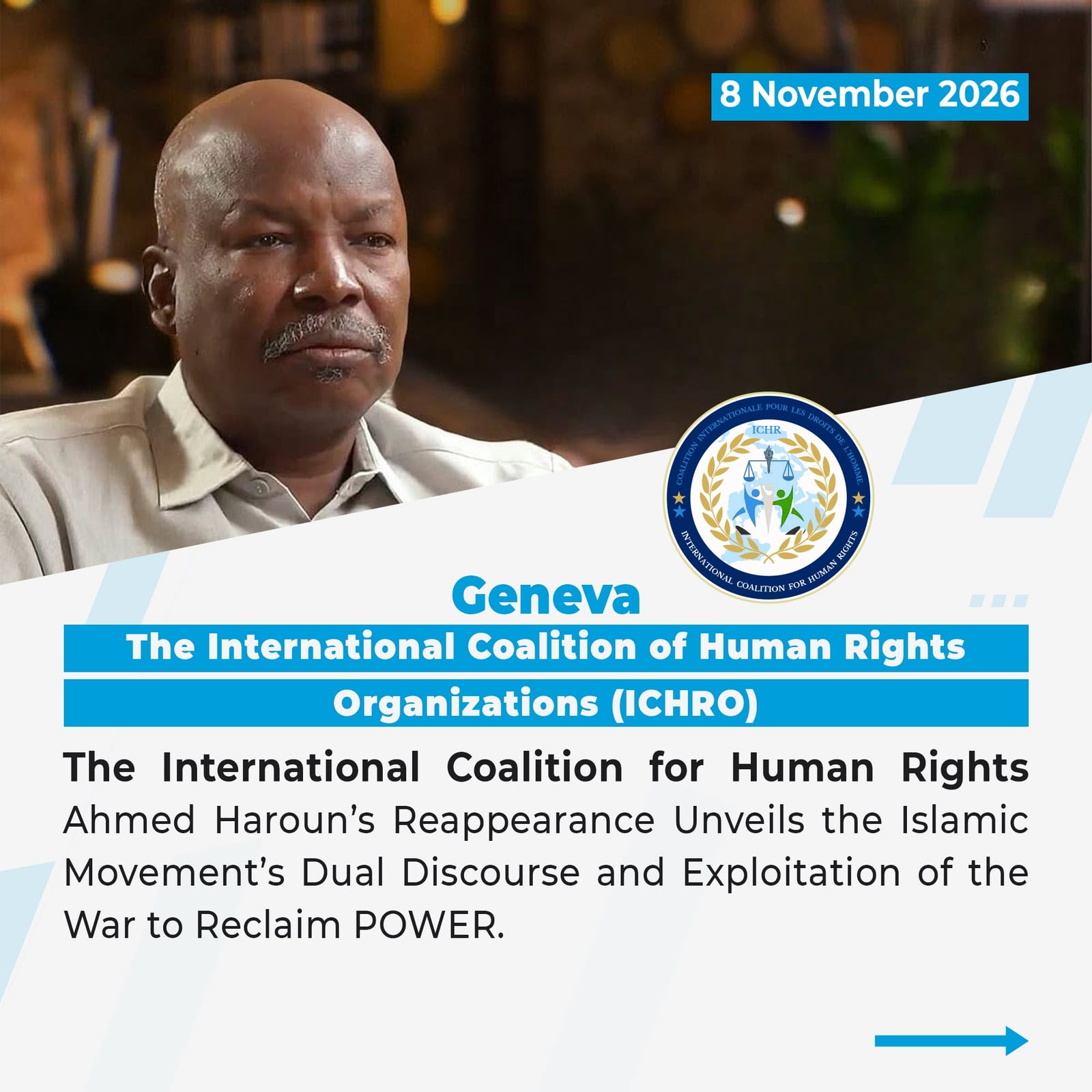
Ahmed Haroun’s Reappearance Unveils the Islamic Movement’s Dual Discourse and Exploitation of the War to Reclaim Power
The Coalition is following with deep concern the media reappearance of Ahmed Haroun, a National Congress Party leader wanted by the International Criminal Court, which it sees as an attempt to return former-regime figures to power. It calls for his immediate arrest and surrender to the ICC.
Addressed to:
- The European Parliament, including its Subcommittee on Human Rights (DROI) and Committee on Foreign Affairs (AFET)
- The European Commission
- The European External Action Service (EEAS)
- The International Criminal Court, The Hague
- The Independent International Fact-Finding Mission for the Sudan, UN Human Rights Council, Geneva
The International Coalition of Human Rights Organizations (ICHRO) is following with deep concern the media appearance of Ahmed Haroun—a prominent leader in the National Congress Party (NCP) and a fugitive wanted by the International Criminal Court (ICC). Following his interview regarding the war, the future of governance, and the Islamic Movement’s relationship with the Sudanese Armed Forces (SAF), the Coalition views his re-emergence as a deliberate attempt to reintroduce leaders of the former regime as key actors shaping Sudan’s future—all while civilians bear the tragic consequences of this struggle for power and persistent impunity.
The Coalition asserts that the content of the interview reinforces its long-standing position: the war in Sudan cannot be understood in isolation from the role of the Islamic Movement, its legacy of politicizing military and security institutions and its systemic efforts to obstruct the democratic transition to regain influence. Reducing the war to a purely military conflict ignores the political and organizational forces that laid the groundwork for its outbreak and are currently exploiting its continuation to reshape power dynamics, depriving the Sudanese people of their right to a civilian, democratic government.
This accountability extends beyond political debate. When the U.S. Department of the Treasury sanctioned Ali Karti in September 2023, it explicitly cited the leadership of the Islamic Movement for undermining the civilian transitional government, impeding the political process, contributing to the conditions that sparked the fighting, and hindering ceasefire efforts. These are established facts that demand accountability; they cannot be brushed aside by reframing the Movement’s political and military role as a defense of the state.
The dual nature of this discourse is evident in Haroun’s denial of any formal organizational link between the NCP and General Abdel Fattah al-Burhan, contrasted with his portrayal of their relationship as an alignment dictated by battle and shared interests. Denying formal party membership does not negate an active political and field alliance, nor does it address the extent of the Islamic Movement’s influence within state institutions or the military’s independence in decision-making.
The Coalition asks: who determines the choices of war and peace, under what mandate, and in whose interest?
Al-Burhan’s leadership cannot be treated as separate from these networks without scrutinizing their actual impact on the conduct and prolongation of the war.
Furthermore, Haroun’s proposal for a hybrid political system that incorporates the military into governance represents a direction that human rights organizations must firmly reject whenever civilian authority is subjected to armed guardianship.
Using the shortcomings of past political experiences to justify continued military intervention merely reproduces the crisis the Sudanese people fought to overcome. The right of citizens to choose and hold their leaders accountable cannot be reduced to power-sharing arrangements between armed factions and former regime networks, while civilians are expected to accept the war’s outcome as the foundation for the next political order.
This double standard reaches its peak when the protection of the state is invoked while citizens’ lives and rights are violated by armed groups fighting alongside the army.
The UN High Commissioner for Human Rights has previously warned of reports regarding summary executions in southern Khartoum attributed to the Al-Baraa Ibn Malik Battalion, targeting individuals accused of collaborating with the Rapid Support Forces (RSF).
These acts warrant an independent investigation and accountability for all responsible parties, including those who issued orders or facilitated them. They cannot be justified by military mobilization or by classifying civilians based on political loyalty or regional origin.
The Coalition emphasizes that civilians who lost their lives, homes, security and their children’s futures must not have their tragedy turned into the price for the Islamic Movement’s return to power.
The insistence of its leadership on regaining influence and resisting a transition that subjects state institutions to civilian oversight has deepened the catastrophe facing Sudan.
A state worthy of protection is one that safeguards its citizens and their rights; it is not protected by enabling a political organization to monopolize its institutions or use war to derail the democratic path opened by the sacrifices of the Sudanese people.
The Coalition’s demands
Haroun’s public appearance places direct responsibility on the authorities led by Al-Burhan to explain why he remains at large.
The Coalition demands a full disclosure of the circumstances surrounding his escape from prison, the entities that facilitated his movements, any political or security protection he receives, and his connections to active officers and decision-making centers.
The Coalition further calls for his immediate arrest and surrender to the ICC, along with an investigation into any official or party role that has prevented his transfer to international justice.
The Coalition urges international and regional partners to review their engagement with influence networks that impede a ceasefire and a civilian transition. It calls for tangible pressure to halt support for entities involved in human rights abuses and to hold perpetrators accountable.
The Coalition warns against any political settlement that grants former regime figures influence in exchange for stalling justice or re-establishing their control under military arrangements.
Ending the war requires confronting the interests that fuel it, protecting civilians and clearing the path for the free will of the Sudanese people.
The Coalition reaffirms its commitment to a professional army, independent of politics and subordinate to civilian authority, and to a democratic path that guarantees accountability and equal participation. Sudan’s destruction must not become a stepping stone for the return of those who obstructed its transition, nor should the sacrifices of its victims become leverage in a battle for control of the state.
INTERNATIONAL COALITION OF HUMAN RIGHTS ORGANIZATIONS
Advancing Human Rights • Peace • Justice
Geneva, 8 November 2026
- #international_coalition_for_h_rights
- #Sudan