GENEVA · 25 AUGUST 2026
Civil Society Panel in Geneva Addresses Systematic Violations Against Women in Sudan, Urges ICC Referral and OPCW Investigation into Chemical Weapons Use
Civil society leaders, human rights defenders and legal experts convened in Geneva on 25 August 2026 for the panel "Women’s Condition and Violence in Wartime: Focus on the Sudan Crisis." Issued jointly by ICHR, EADM, TYFA and Post Versa, the statement urges an independent fact-finding mission with OPCW participation, ICC referral without immunity, and the meaningful participation of Sudanese women in all peace processes.
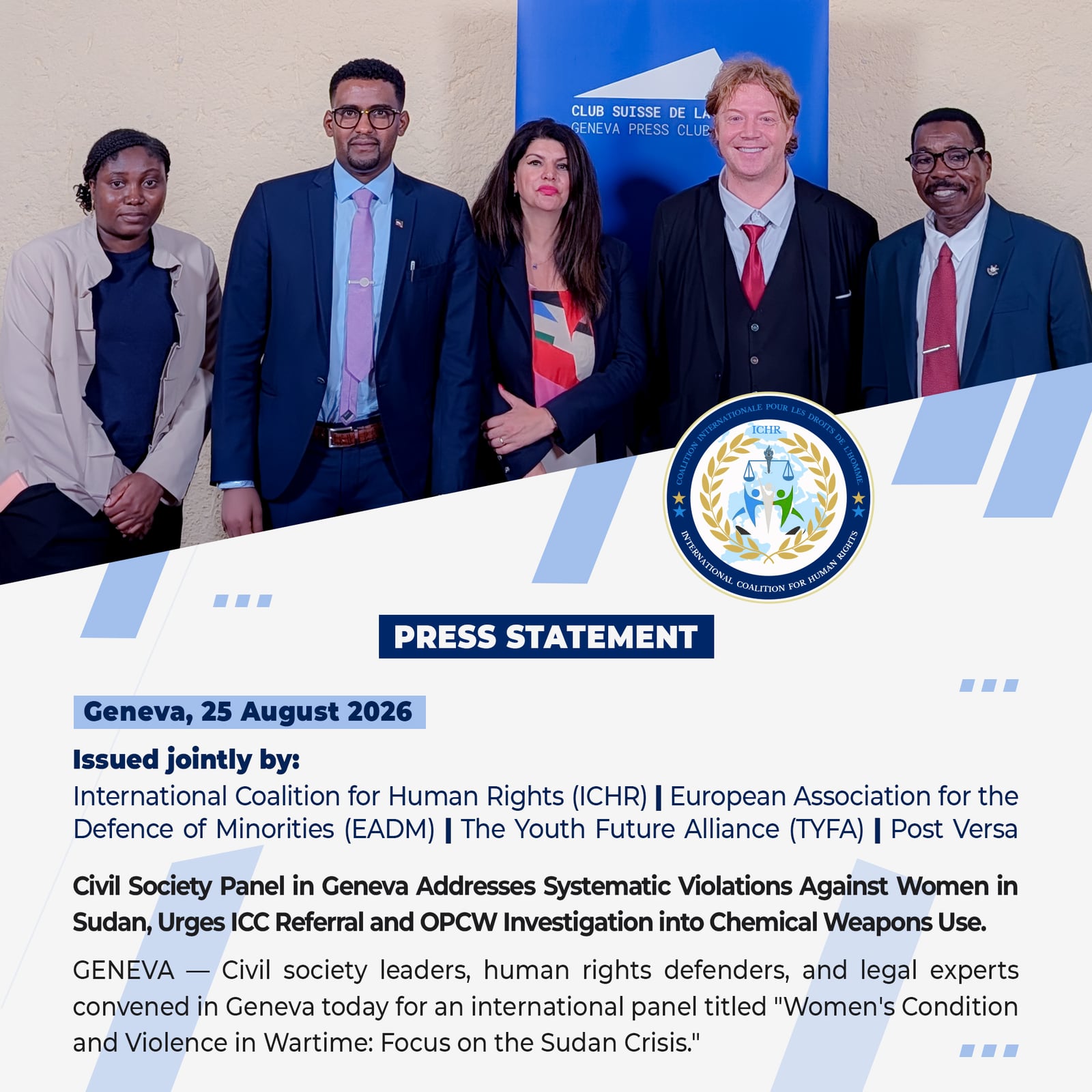
Issued jointly by the International Coalition for Human Rights (ICHR), the European Association for the Defence of Minorities (EADM), The Youth Future Alliance (TYFA) and Post Versa.
GENEVA — Civil society leaders, human rights defenders and legal experts convened in Geneva on 25 August 2026 for an international panel titled "Women's Condition and Violence in Wartime: Focus on the Sudan Crisis."
The session examined the severe deterioration of human rights and international humanitarian law standards in Sudan, with a focus on gender-based violence, the destruction of civilian infrastructure, and reported chemical weapons employment.
The panel comprised:
- Ramon Rahangmetan — Co-founder, Circle of Sustainable Europe
- Manel Msalmi — President, EADM; Advisor on MENA Affairs, European Parliament
- Andy Vermaut — Vice President, EADM; President, World Council for Public Diplomacy and Community Dialogue
- Abdelrahim Grein — Representative, ICHR
- Dr. Mohamed Ali — ICHR
Core human rights findings presented
Panellists presented evidence detailing grave violations of international human rights and humanitarian law across Sudan.
Gender-based and sexual violence. Interventions underscored that sexual violence, rape and forced displacement are being utilised systematically as instruments of warfare. Speakers highlighted that these atrocities reflect long-standing patterns of structural violence and cause enduring physical and psychological trauma to survivors.
Chemical weapons allegations. Submissions highlighted documented incidents from Omdurman (2024) involving chemical agents attributed to the Sudanese Armed Forces (SAF). Presenters detailed severe, long-term health consequences for exposed civilian populations, particularly women and children, including respiratory failure and congenital physical deformities.
Militarisation of essential infrastructure. Reports indicate that over 80 percent of health facilities in active conflict zones have been rendered non-functional, destroyed, or converted to military use. The targeted destruction of medical facilities, schools and essential utility infrastructure has crippled maternal care and access to basic education.
Joint call to action
The co-organising human rights organisations call upon the United Nations, the European Union, the International Criminal Court (ICC), the Organisation for the Prohibition of Chemical Weapons (OPCW) and the broader international community to implement the following priority measures.
Accountability and justice. Establish an independent, international fact-finding mission with technical OPCW participation to investigate alleged chemical weapons use and gender-based crimes, with a direct referral of perpetrators to the ICC without immunity.
Civilian protection. Mandate and enforce a robust protection framework, including a comprehensive no-fly zone over civilian population centres, to mitigate indiscriminate aerial bombardment and drone strikes.
Humanitarian access. Guarantee immediate, safe and unhindered humanitarian corridors across all territorial boundaries to deliver emergency medical care, food relief and reproductive healthcare services.
Survivors' support. Direct dedicated international funding toward survivor-centred medical, psychological and specialised toxicological care for victims of chemical agent exposure and conflict-related sexual violence.
Women, peace and security. Ensure the direct, meaningful and non-tokenistic participation of Sudanese women in all formal peace negotiations, transitional mechanisms and constitutional processes, pursuant to UN Security Council Resolution 1325.
Contextual background and key data
Forced displacement. According to UNHCR data (April 2026), approximately 14 million people — nearly one-quarter of Sudan's population — have been displaced since April 2023, including over 4.4 million refugees seeking protection across international borders.
Acute food insecurity. Over half of the civilian population faces emergency levels of food insecurity, with famine conditions verified across multiple regions.
Ongoing violence in Kordofan. UN OCHA reports confirm that over 200,000 individuals have experienced recent displacement in the Kordofan region following sustained strikes on civilian infrastructure.
Media contacts
European Association for the Defence of Minorities (EADM) — WCPDCD.eadm@gmail.com · Facebook
The Youth Future Alliance (TYFA) — www.theyfa.com
Full statements, technical reports and legal submissions are available to international monitoring bodies upon request.
THE INTERNATIONAL COALITION FOR HUMAN RIGHTS
Advancing Human Rights • Peace • Justice
Geneva, 25 August 2026
Gallery
- #international_coalition_for_h_rights
- #Sudan
- #Geneva